

How To Clean Glass Slides For Photolithography
Artículos de investigación
July A. Galeano julygaleano@itm.edu.co
Instituto Tecnológico Metropolitano, Colombia
Patrick Sandoz psandoz@univ-fcomte.fr
University Bourgogne Franche-Comté, Francia
Artur Zarzycki arturzarzycki@itm.edu.co
Instituto Tecnológico Metropolitano, Colombia
Laurent Robert lrobert@femto-st.fr
University Bourgogne Franche-Comté, Francia
Juan M. Jaramillo jjaram44@eafit.edu.co
Universidad EAFIT, Republic of colombia
Microfabrication of position reference patterns onto glass microscope slides for loftier-accurate analysis of dynamic cellular events
TecnoLógicas , vol. 20, no. 39, pp. 115-126, 2017
Instituto Tecnológico Metropolitano
Received: 28 March 2017
Accepted: 03 May 2017
Abstract: Glass microscopes slides are widely used as in situ base-substrates carrying diverse micro-made systems or elements. For such purposes, the micro-fabrication process consists in transferring a pre-defined pattern onto the substrate fabricated of a glass microscope slide. This is known as patterning, which is a technique that can as well exist used in transferring specific designs that allows region of involvement (ROI) recovery under the microscope. In those cases, two main challenges appear: 1) Disturbances in calorie-free manual should remain minimum to continue the high quality of observation of the object of interest under the microscope. ii) The pattern-size should and then be pocket-sized plenty just, however, larger than the diffraction limit to exist observable satisfactorily for positioning purposes. In this article, we present the procedures involved in the microfabrication of Pseudo-Periodic Patterns (PPP) encrypting the accented position of an extended area. Those patterns are embedded in Pétri dishes in lodge to allow the high-accurate retrieval of absolute position and orientation. The presented microfabrication is based in a technique known as lift-off, which after parameter adjustment, allows the obtaining of PPP fulfilling the two previously mentioned requirements. The results written report on PPP realized on drinking glass microscope slides and equanimous by 2µm side dots made of aluminum with a thickness of 30nm.
Keywords: Microtechnology, lift-off process, pseudo-periodic patterns, drinking glass microscope slides, micropatterning.
Resumen: Los portaobjetos de microscopio se utilizan ampliamente como sustratos base in situ para la realización de diversos sistemas o elementos microfabricados. Para estos fines, el proceso de microfabricación consiste en transferir united nations diseño predefinido sobre el sustrato correspondiente a una lámina de vidrio utilizada como portaobjetos de microscopio. Este proceso se conoce como "patterning", que es una técnica que también se puede utilizar en la transferencia de diseños específicos que permite la recuperación de una región de interés (ROI) bajo el microscopio. En estos casos, aparecen dos desafíos principales: ane) Las perturbaciones en la transmisión de la luz deben permanecer mínimas para mantener la alta calidad de observación del objeto de interés bajo el microscopio. 2) El tamaño del patrón debe ser entonces suficientemente pequeño, pero, sin embargo, mayor que el límite de difracción para ser observable satisfactoriamente para propósitos de posicionamiento. En este artículo presentamos los procedimientos involucrados en la microfabricación de Patrones Pseudo-Periódicos (PPP) los cuales encriptan la posición absoluta de un área extendida. Esos patrones están embebidos en placas de Pétri para permitir la recuperación absoluta y de alta precisión de una ROI, al igual que su orientación. La microfabricación presentada se basa en una técnica conocida como "lift-off" que, tras el ajuste de parámetros, permite la obtención de PPP cumpliendo los dos requisitos anteriormente mencionados. Los resultados corresponden a la realización de PPP en portaobjetos de vidrio y compuesto por puntos laterales de 2μm hechos de aluminio con un grosor de 30nm.
Palabras clave: Micro-tecnología, proceso lift-off, patrones pseudo-periódicos, láminas cubre-objetos de vidrio, micropatterning.
1. INTRODUCTION
Drinking glass microscope-slides are widely used by biologists in order to find, analyze, and quantify cellular events and biological samples. Given their uses and its physical backdrop, microscope slides are used present as base-substrates for the development of microfabrication-based devices such equally microfluidics and Lab-on-a-Chip [1]–[4]. The fabrication of those devices requires a previous pace of micro-patterning. This consists in transferring a pre-defined design onto the substrate by means of techniques such every bit mask UV-lithography, mask-less lithography systems such as light amplification by stimulated emission of radiation-direct-writing-lithography, and inkjet printing [v], [six]. The design corresponds, in most of the cases, to micrometric features. The use of any of the above-mentioned techniques depends on the capacities of the micro-technological facility, existence mask-less lithography a more than flexible technology allowing the fabrication of shapes with a minimum feature size as small every bit a few nanometers [7], [8].
Micro-patterning can also be used in applications that implies a simple design-transfer directly onto the microscope slide, without the demand of embedded electronics. This is the example of applications where region of interest (ROI) recovery is needed either for absolute alignment or for cell-migration quantification and follow-up. In these cases, the micrometric features allow the absolute localization of the observed areas with diverse ranges of resolution and accuracy with respect to the whole substrate. Such paradigm registration is indispensable to document the dynamic changes occurring in alive jail cell cultures over fourth dimension.
For ROI recovery, unlike approaches have been proposed, almost of them corresponding to alpha-numeric patterns that, once embedded in Pétri-dishes or microscopes-slides, offer a visual manner for ROI positioning. Although those types of patterning are nowadays commercialized and used by many biologists, the allowed performances are coarse and constitute a major limiting factor for high-accurate analysis of cellular events. This trouble has been addressed past diverse authors who proposed several approaches that, in most cases, require the patterning of pocket-sized-sized features [9]–[13]. As an example, we can reference the design presented by Dominic et al. [9]. This pattern consists in a variable width line reference grid in social club to uniquely narrate every intersection, and at the aforementioned time every position, within a working surface.
In our example, we proposed to transfer specific pseudo-periodic patterns (PPP) onto the ground side of Pétri-dishes. The PPP consists of a regular distribution of 2µm sized dots where some of them are absent. The pseudo-periodic distribution allows further Fourier processing for high-authentic but relative positioning, while the absenteeism/presence of dots stand for to an encrypted binary code that allows absolute but coarse positioning. Unlike from the mentioned approaches, our method too allows orientation measurement. The principle of the method proposed to retrieve a zone of involvement under microscope is presented in [14].
The main challenges in microscope's slide patterning are: 1) to obtain a configuration where it is possible to obtain the minimum of losses in light intensity while observing under microscope [15], two) obtain blueprint'south size close to the diffraction limit of the low-cal in accordance with the lens used in practice, in this example 2µm with classical UV-lithography process, in club to guarantee loftier-resolution positioning measurement. The modest thickness of the substrate (~120µm) makes too challenging to comply with the fragility of the samples.
In order to face up the previous mentioned challenges, the patterning of jail cell-culture dishes presented in this piece of work was done using micro-technology procedures, specifically through an adapted elevator-off procedure. The procedure consisted in patterning a glass microscope cover-slip, which was then inserted in a plastic Pétri dish. The desired patterning is as presented in Fig. 1. The idea is to class a picture of the designed PPP, [fourteen], [xv], over the surface of the drinking glass microscope encompass-slips (the substrates). The PPP will exist formed with aluminum where the present dots correspond to the aluminum covered areas, while the absent dots and background is the transparent substrate itself.
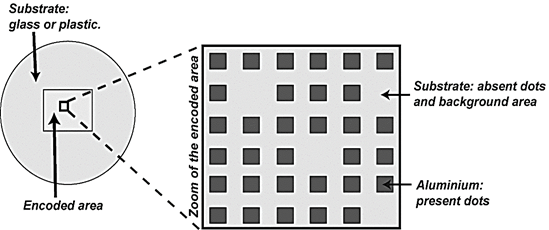
Fig.1.
Desired substrate patterning: a substrate of interest is patterned with a predesigned PPP, using the elevator-off process. The idea is to represent present dots past aluminum covered areas. Absent dots and background represent to the transparent substrate itself.
Source: authors.
This article presents the procedure of microfabrication of those PPP, indicating the obtained results also as the issues encountered. During the following sub-sections, we present the technological process to follow in lift-off for substrate patterning.
2. MATERIALS AND METHODS
2.i Technological realization of PPPs
Lift-off is one of the common processes of patterning a substrate using a metal layer. It does non require special aggressive etchants, which in our instance would destroy the substrate. Information technology is quite elementary and gives skilful results. In general, the lift-off method comprehends the post-obit steps: photolithography, metallization, resist stripping and metallic lift-off.
Below, each step is described in more details. Firstly, however, we present the mask, which is necessary to perform photolithography [16], [17].
2.2 A photolithography mask
A photolithography mask is a piece of glass containing on one side geometric features that are either transparent or not-transparent to UV light. Those features form the design that is desired to be reproduced past photolithography, in our case a PPP. For the patterning of the substrates used in this work, we designed a mask in order to be used in negative photolithography procedures (described in the post-obit items). The mask was designed and elaborated in a chromium-covered silica glass slide.
2.3 Photolithography
Photolithography is the basic process in microfabrication. The process corresponds to a design transfer from a mask onto a substrate covered by UV- sensitive photoresist. For this, three types of photoresist can be used: positive, negative and epitome reversal. In all the cases, the photoresist-covered substrate is exposed to UV-light through a mask. The diverse process is based on the unlike reaction of the exposed areas versus non-exposed areas. The main divergence in those types of photoresist are explained as follow: in positive photoresist, the exposed areas in the photoresist are removed during the development step while the unexposed areas remain; in negative photoresist the reverse result is obtained: the exposed areas in the photoresist remain while the unexposed areas are removed during the development footstep. Results obtained with reversal photoresist tin be like those from positive or similar from negative photoresist, depending on the applied procedure. In our case, for PPP patterning, we used the final mentioned photoresist.
Due to very minor elementary dimensions of the desired design (grid of squares of 2 µm border's length) a photoresist characterized by extended resolution capabilities was used, in our case TI09XR [16], which is an image reversal type photoresist. This image reversal type photoresist was used in a negative style over the glass-slides substrates. In this way, a negative mask was designed and used. The procedure of photolithography onto the mentioned substrate is depicted in Fig. 2 and involve the following steps:
1. Process starts from coating the substrate by photoresist layer, TI09XR, of nigh 700 nm thickness. This is done past a spin coating method with parameters as follow: speed - 4000 r/min, acceleration: 4000 r/min/due south, time: thirty sec. After that, photoresist is subjected to soft bake; substrates are put on a hot plate for 50 secs at a temperature of 100°C.
2. In the second step, photoresist is exposed to UV lite with dose of 45 mJ/cm.. Exposure is done through the negative mask.
three. After exposure, the photoresist is subjected to reversal bake. During the reversal bake, the exposed resist areas are converted and become insoluble in the developer, while the resist so far unexposed remains without any changes and can exist exposed afterward. Reversal bake is done on a hot plate for i min at a temperature of 130 °C.
iv. The quaternary step consists in the alluvion exposure of photoresist with dose of 190 mJ/cm.. For this exposure we do non apply whatever mask. The overflowing exposure makes previously unexposed areas soluble in developer.
5. The last, fifth step, is development. As in previous process, nosotros immerse the substrate in standard developer MF-26A for 35 sec. During development, areas exposed first remain whereas unexposed are stripped.
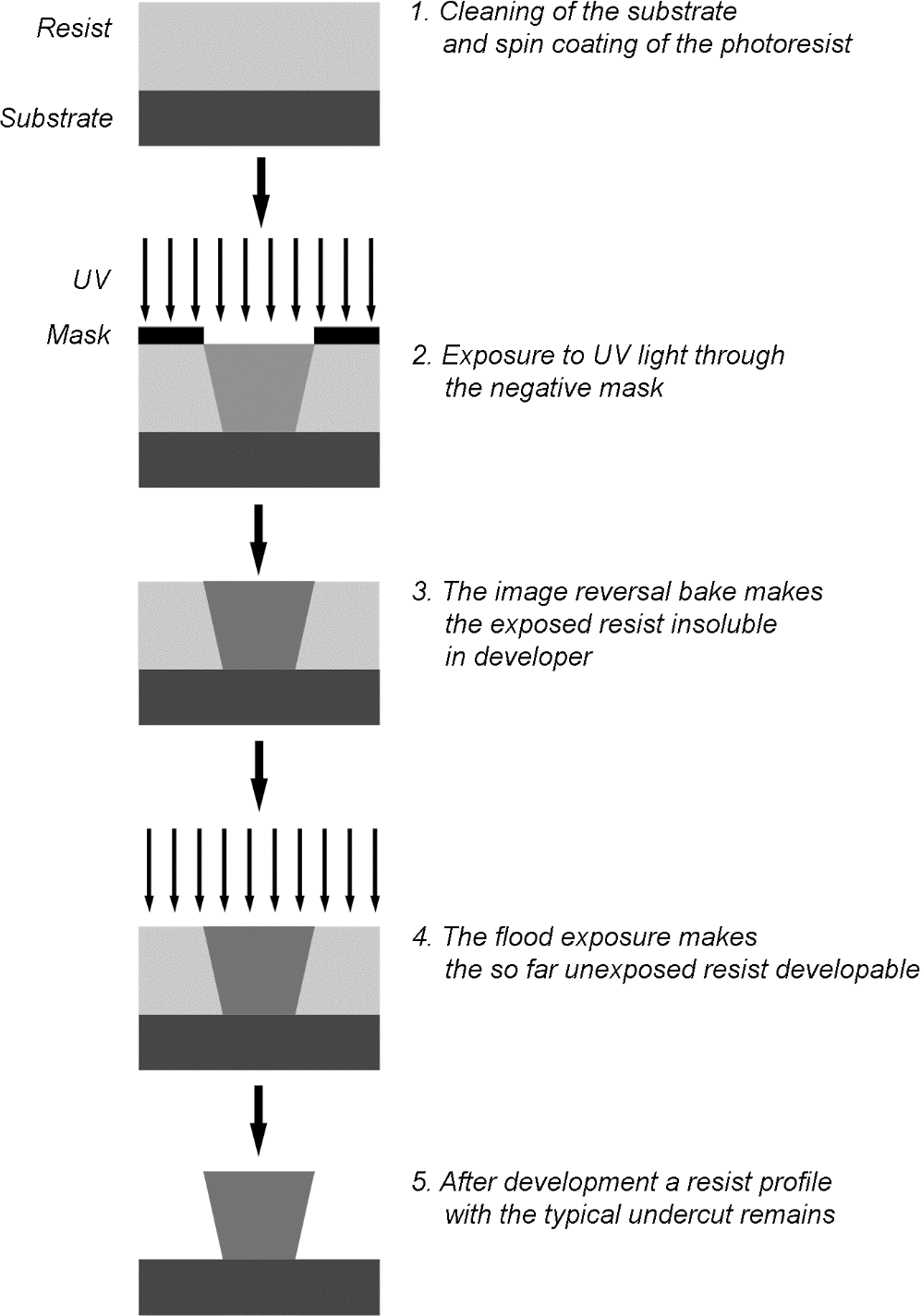
Fig. 2.
The sequence of paradigm-reversal resist processing every bit a negative photoresist.
Source: authors.
One must notice a negative contour of the photoresist's walls. A negative profile ways that the pattern width is smaller at its bottom than at its top, which is typical for negative photoresists.
two.4 Metallization
In that location are two ways to perform metallization on a substrate: evaporation and sputtering. During the evaporation procedure, the substrate is placed in a high vacuum sleeping room at room temperature. The chamber has a crucible, placed nether the substrate, that contains the fabric to exist deposited—aluminum, in our case. The crucible is then heated causing the material to evaporate and condense on all the exposed cooler surfaces of the substrate and vacuum sleeping accommodation as well.
In the case of sputtering, the substrate and a target (the cloth to be deposited) are placed in a vacuum chamber. Plasma is generated in a side gas source in the sleeping accommodation, and the ion bombardment is directed towards the target. This causes cloth to exist sputtered off the target and condense on the substrate.
For lift-off purposes, metal deposition past evaporation gives much better results. Evaporated aluminum spreads out from the source radially. Information technology falls perpendicularly onto the substrate'due south surface due to the significant distance from the target source. This causes the photoresist's sidewalls with negative profile to remain clear (Fig. 3). In the case of a positive contour, the sidewalls would be slightly covered. On the other paw, during sputtering, metallic spreads out from the target in a very cluttered way. Moreover, the target is bigger in bore than the substrate and much closer to the substrate'due south surface. As a effect, particles of aluminum land everywhere and create a continuous layer. Metallic is deposited fifty-fifty on the photoresist's sidewalls with negative profile. Even so, the thickness of the metal layer on them is negligible. Nosotros used evaporation to fabricate PPPs. The thickness of the aluminum in the PPPs ranged from 30 nm to 100 nm.
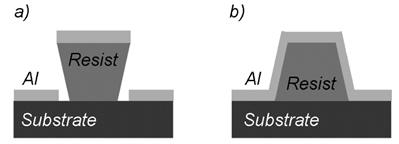
Fig. iii.
Scheme of metallic profiles after: (left) sputtering or evaporation on reversal photoresist contour; (rigth) evaporation on positive photoresist profile. Only negative sidewalls in combination with evaporation go along the resist sidewalls uncoated even in case of thick coatings
Source: authors
In future works it will be of import to consider the use of other metals for the PPP. The point is achieving sufficient opaqueness and light upkeep ensuring the right acquisition of cell images nether the microscope. Ii parameters greatly determine the opaqueness level: the thickness of the metal on the microscope slide and the extinction coefficient of the material. As presented in [8], the calorie-free budget can exist estimated from the dots' transparency and the configuration of the PPP (the number of dots in the field of view). We calculated a light budget of 85%, for the aluminum and PPP configuration used in this work. This value was enough for the application.
ii.5 Elevator-off
Finally, the lift-off step is performed. Substrate is immersed in a liquid fabricated of a powerful photoresist solvent that is chemically inert on glass and metal. One time the dissolved photoresist is stripped out from substrate, the aluminum layer over it is lifted-off, while the metal deposited directly on the substrate remains. Remaining areas of aluminum form the final PPP on the substrate.
3. RESULTS
Final results are presented in Fig. iv for the photoresist patterning on coverslip glasses using paradigm reversal photoresist as a negative one.
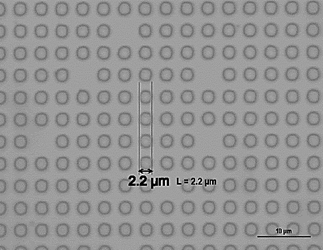
Fig.4.
Final results in photolithography obtained with image reversal photoresist used as negative on cover-slip glass. Information technology is possible to see the design size (around 2µm) with a period of 4µm.
Source: authors.
3.1 Technological problems
There are some issues that tin can be encountered during photolithography. In our case, the primary issues that affected the process were related to substrate resist mask adjustment, first exposure dose/reversal broil, and development:
three.1.1 Substrate-resist-mask adjustment
Here we use the word adjustment to make reference to the junction of the substrate (covered past photoresist) with the predesigned mask, for UV exposure. Commercial UV lamps are already equipped with a specific device to perform this adjustment automatically. In our case, manual adjustment is performed due to the particular size and shape of our substrates that brand impossible to use the specialized machine available.
iii.one.two First exposure dose
Fig. 5 shows that a high dose during the first exposure (a1) results in a steep resist contour with small-scale undercut (a2) after reversal broil, flood exposure, and development. Conversely, a depression dose during the first exposure (b1) that does not bear upon the resist layer near the substrate produces a potent undercut and sometimes the peeling of narrow resist structures in the developer (b2). Therefore, the optimum dose of the start exposure depends on the desired undercut and the minimum lateral feature sizes [xvi].
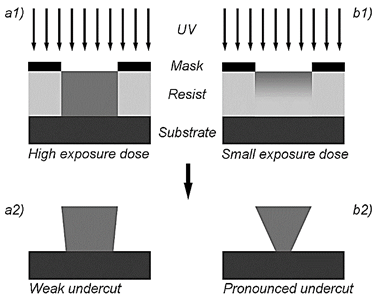
Fig.5.
The exposure dose strongly impacts the lineal resist profile. Loftier exposure doses homogeneously betrayal the resist film towards the substrate, the resist contour shows almost no undercut. Depression exposure doses go along the substrate-near resist rather unexposed and therefore maintain a high development charge per unit thus achieving a pronounced undercut.
Source: image adjusted from [xvi].
3.one.3 Evolution
The undercut forms in the last stage of evolution, according to the development time, are presented in Fig. 6. Information technology is important to apply a considerable development fourth dimension (normally to obtain xxx% of over-developing) that avoid the presence of photo-resist in the forming undercuts. The presence of photo-resist in the undercuts yields to incorrect patterning of the substrate since the metal will non be deposed directly on the substrate [16].
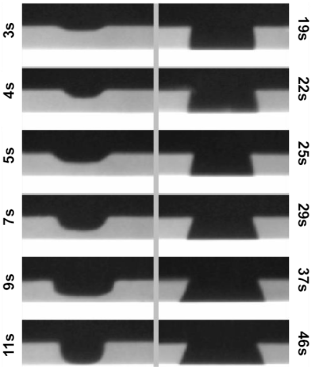
Fig.6
A serial of cantankerous-sections of an paradigm reversal resist in different stages of evolution. The undercut develops mainly after the substrate is already cleared. The fourth dimension specification given refers to the evolution first.
Source: epitome taken from [16].
In order to avoid the issues related to exposure dose and development time, several tests were done in clean room in order to detect the correct values for acceptable photoresist patterning. As example, Fig. 7 shows a bad photoresist patterning when using a high value in first exposure dose. The problem was solved, afterward several tests, when using a center value in first exposure dose (45 mJ/cmii).
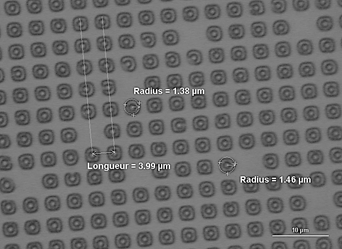
Fig.7.
Case of incorrect photoresist patterning. Photoresist is still present (at the center of the dots) in the areas covered past the mask during get-go exposure dose. This problem was solved by adjusting the exposure dose.
Source: authors.
The obtained patterned cover-slips were embedded in Pétri dishes besides equally in well plates. A way to do this, was just by gluing them at the external bottom side of the dish (Fig. 8). Another mode is by using PDMS (Poly-Di-Methyl-Siloxane: a biocompatible polymer) in order to embrace the glass-cover slips and then gluing it in the internal part of the Pétri dish or plate. For PDMS preparation, we used a standard process that implies the utilise of the PDMS itself together with a curing agent, as presented in the following [18]:
1. Mix the curing amanuensis with the PDMS, by conserving a weight ratio between them of 1:10.
2. Degas the previous training past using a vacuum pump: this in social club to remove the bubbling that could be acquired during the mixing procedure.
three. Pour the preparation over the PPP substrate.
iv. Centrifugate the substrate with the PDMS mixture for 40 secs to obtain a uniform PDM Due south layer on the substrate.
5. Place the substrate in an oven at 80°C for 8 hours to soft bake the PDMS mixture.
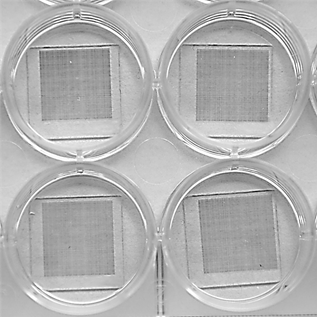
Fig. viii
Patterned cover-slip embedded in a well plate.
Source: authors.
Both, the PDMS layer and the cell-civilization box thickness form the necessary acme distance betwixt the PPP and the biological material to exist observed under the microscope. This distance avoids image crosstalk during the image acquisition of either the cell-civilization or the PPP. The processing of the PPP epitome allows to measure in a precise style the position of the jail cell-culture under observation every bit reported elsewhere [15].
4. CONCLUSIONS
T This newspaper presents the patterning of glass microscope slides for authentic recovery of the Region of Interest (ROI) form cell cultures. Microscope slide patterning poses ii challenges: avoiding lite transmittance losses and making the pattern'due south size compatible with the diffraction limit of optical microscopes. In order to overcome these bug, we suggest to employ a microfabrication technique known every bit "lift-off" for patterning drinking glass coverslips. The patterned coverslips are so embedded in Petri dishes to be later used in precise ROI localization.
The elevator-off process used in this work comprises the following primary steps: photolithography, metallization, resist stripping, and metal lift-off. The photolithography process involves a mask (designed by the authors) composed of a PPP (feature size = 2µm side). This is small enough to minimize light transmission disturbances while sufficiently big to exist resolved by mid-range numerical aperture lenses. For such minor dimensions, a high resolution photoresist must be used. In this work we used TI09XR. The combination of this resist and an advisable exposure time and dose (45 mJ/cm2) during development ensure a pattern that is modest and reliable enough for accurate ROI localization (by suitable epitome processing techniques). In the instance of metallization, the evaporation facilitated the fabrication of 30nm thick aluminum dots. This set of values minimizes the losses of light transmittance during microscope observations. It also aids automatic and highly accurate position retrieval when the patterned slides are placed on Petri dishes or other devices supporting the prison cell cultures.
Further studies will focus on the development of this kind of patterns for applications in other domains (such as precise control and robotics). They will also address the structure of flexible low-cost lithography machines for the fabrication of such patterns without the need of a mask.
Acknowledgments
The authors acknowledge the RENATECH network and its FEMTO-ST technological facility MIMENTO. Also, nosotros acknowledge the fiscal support given past Instituto Tecnológico Metropolitano (Medellin-Colombia), and past Institute FEMTO-ST (Besancon- France), under the project number P15201.
6. REFERENCES
[1] R. Ramji, N. T. Khan, A. Muñoz-Rojas, and K. Miller-Jensen, "'Popular-slide' patterning: rapid fabrication of microstructured PDMS gasket slides for biological applications," RSC Adv., vol. 5, no. 81, pp. 66294–66300, 2015.
[2] B. Gumuscu, A. den Berg, and J. C. T. Eijkel, "Custom micropatterning of hydrogels in closed microfluidic platforms made past capillary pinning," in The 18th International Briefing on Miniaturized Systems for Chemistry and Life Sciences, 2014.
[3] J. Lafaurie-Janvore, East. E. Antoine, South. J. Perkins, A. Babataheri, and A. I. Barakat, "A elementary microfluidic device to study cell-calibration endothelial mechanotransduction," Biomed. Microdevices, vol. eighteen, no. 4, p. 63, Aug. 2016.
[4] N. Nagarajan, K. Hung, and P. Zorlutuna, "Protein Micropatterning Techniques for Tissue Engineering and Stem Cell Research," in Cell and Material Interface: Advances in Tissue Engineering, Biosensor, Implant, and Imaging Technologies, vol. 52, CRC Press, 2015, pp. 109–146.
[5] J. Jaramillo, A. Zarzycki, J. Galeano, and P. Sandoz, "Functioning Characterization of an xy-Phase Applied to Micrometric Light amplification by stimulated emission of radiation Direct Writing Lithography.," Sensors (Basel)., vol. 17, no. ii, p. 278, Jan. 2017.
[6] C.-T. Chen, "Inkjet Printing of Microcomponents: Theory, Design, Characteristics and Applications," in Features of Liquid Crystal Display Materials and Processes, InTech, 2011, pp. 43–sixty.
[7] G. Boolchandani and B. Sarita, "A Review Paper on Nanotechnology Applications and Concepts," in IJIRST || National Briefing on Innovations in Micro-electronics, Signal Processing and Communication Technologies (V-Bear on-2016), 2016, pp. 61–62.
[8] A. Nag, A. I. Zia, Due south. C. Mukhopadhyay, and J. Kosel, "Functioning enhancement of electronic sensor through mask-less lithography," in 2015 9th International Conference on Sensing Technology (ICST), 2015, pp. 374–379
[9] D. St-Jacques, S. Martel, and T. B. FitzGerald, "Nanoscale Grid based potitioning system for miniature instrumented robots," in Canadian Conference on Electric and Figurer Engineering, 2003, vol. 3, pp. 1831–1834.
[ten] D. B. Boyton, "Position encoder using statistically biased pseudorandom sequence." 2004.
[11] V. Guelpa, P. Sandoz, 1000. A. Vergara, C. Clévy, N. Le Fort-Piat, and G. J. Laurent, "2d visual micro-position measurement based on intertwined twin-scale patterns," Sensors Actuators A Phys., vol. 248, pp. 272–280, Sep. 2016.
[12] Grand. J. Yao, "Method of press location markings on surfaces for microscopic research." 2013.
[xiii] M. Wrenn and D. Soenksen, "Systems and methods for tracking a slide using a composite barcode label." 2016.
[14] J.-A. Galeano-Zea, P. Sandoz, E. Gaiffe, J.-Fifty. Pretet, and C. Mougin, "Pseudo-Periodic Encryption of Extended two-D Surfaces for High Accurate Recovery of any Random Zone by Vision," Int. J. Optomechatronics, vol. 4, no. ane, pp. 65–82, Jan. 2010.
[15] J. A. Galeano Z., P. Sandoz, E. Gaiffe, S. Launay, L. Robert, M. Jacquot, F. Hirchaud, J.-50. Prétet, and C. Mougin, "Position-referenced microscopy for live cell culture monitoring," Biomed. Opt. Express, vol. 2, no. 5, p. 1307, May 2011.
[16] One thousand. GmbH, Lithography: Theory and Applications of Photoresists, Developers, Solvents and Etchants. MicroChemicals GmbH, 2007.
[17] One thousand. J. Madou, Manufacturing techniques for microfabrication and nanotechnology, 1st ed., vol. two. Boca Ratón - Florida: CRC Press, 2011.
[18] Elveflow, "How to practice PDMS lithography replication from a su-viii mold: The PDMS lithography replication process: tips and tricks," The SU-8 mold fabrication process: tips and tricks. [Online]. Available: http://www.elveflow.com/microfluidic-tutorials/soft-lithography-reviews-and-tutorials/introduction-in-soft-lithography/pdms-softlithography-replication/
Additional information
Cómo citar / How to cite: J. A. Galeano, P. Sandoz, A. Zarzycki, 50. Robert and J. M. Jaramillo, "Microfabrication of position reference patterns onto glass microscope slides for high-accurate analysis of dynamic cellular events", TecnoLógicas, vol. 20, no. 39, 2017. https://doi.org/10.22430/22565337.695
Alternative link
https://revistas.itm.edu.co/alphabetize.php/tecnologicas/article/view/695/677 (html)

Source: https://www.redalyc.org/journal/3442/344251476014/html/
Posted by: augustthoted.blogspot.com
0 Response to "How To Clean Glass Slides For Photolithography"
Post a Comment